Animated video or live action: choose by what has to be seen
What research does and does not say about animation, and a way to choose between animating, filming and recording a screen.
First published at this address: · Rewritten by Moovly Team,
Answers to “animated or live-action?” often come as a list of which looks more modern or more trustworthy. We know of little evidence for any of that. What research does offer is narrower and more useful: when moving pictures help people understand something, and when they do not. This article starts there, and then gives a way to choose by what your video has to show.
One limit first. We found research comparing animation with still pictures, and research on what makes an explanatory video work. The few experiments known to us that set an animated ad against a filmed or human one are about prescription drug ads and print ads; they are described in our article on reasons to use animations in video marketing. They do not settle the question for other products, so nothing below claims that one of them sells better.
What research says about animation
Animation is not automatically better at explaining. A 2021 paper in the journal Instructional Science sums up three meta-analyses that compared learning from animations with learning from still pictures: one of 76 comparisons (2007), one of 140 (2016) and one of 82 (2019). All three found an advantage for animation, and all three found it small.
The same paper reports where the advantage is real: when the thing to be learned is the change itself, how something moves, speeds up, or unfolds in time. In its own experiment with 88 university students, those who watched an animation of a gear mechanism were best at identifying its motions, and those who studied a single still picture were best at identifying how its parts were arranged; a sequence of four pictures did no better than the animation on either task. It also quotes a standard textbook’s advice to use still illustrations unless there is a compelling reason for animation.
These were students learning mechanisms, not customers watching an ad. The finding that carries over is modest: movement earns its place when movement is the point.
What research says about a person on camera
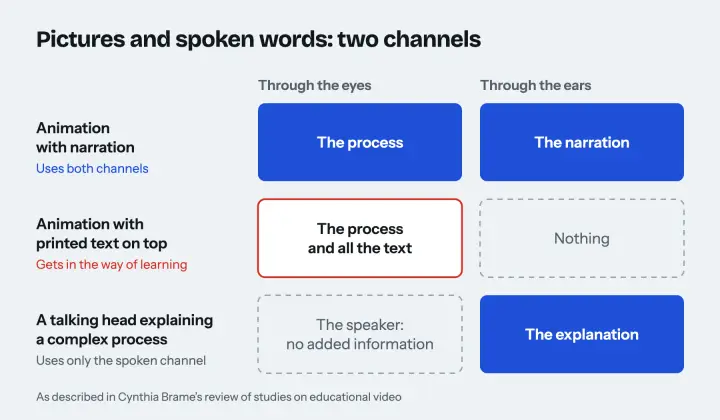
A review of research on educational video makes a matching point about filming. A “talking head” explaining a complex process uses only the spoken channel, because watching the speaker adds no information about the process, whereas narration over drawings that illustrate it gives the viewer two complementary streams. The review also notes that extras such as music and busy backgrounds can reduce learning, and that applies to animation and film alike.
Choose by what has to be seen
- A real thing, place or person: film it. A product someone will hold, a shop they will walk into, the person who will do the work. Viewers want to see the actual object, and a drawing of it answers a different question. A customer speaking belongs here too.
- Something that cannot be filmed: animate it. How data moves between systems, what happens inside a machine, a process that takes months. If the point is how it changes over time, animation is where the research is on your side.
- An arrangement or a structure, not a movement: consider one still picture, or a few, with narration. In the experiment above a single still picture was best for learning how parts are arranged, and the textbook the paper quotes recommends a series of still frames over an animation for explaining how a system works; either is far less work than animation.
- Anything on a screen: neither. Software, a website or a form is best shown as it is, with a screen recording. The Screen Recorder records a screen, a window or a browser tab with your voice, in the browser.
- An idea with a human reason behind it: mix them. A person on camera for the first seconds to say why it matters, then drawings or the screen for the explanation, so the face is not asked to carry a process. The Webcam Recorder covers the first part.
The practical differences
No figures here, because costs depend entirely on who does the work; these are the differences in kind.
- Making it. Filming needs a place, light, sound and the people on the day. Animation needs none of those and a good deal of time at a desk. A screen recording needs the least of either.
- Changing it later. An animation or a screen recording can be redone a section at a time. Filmed material usually means gathering the same people and place again, so film what will stay true: the person and the product, not this year’s price.
- People. Anyone you film has to agree to it, and may leave the company. An animation has no such dependence.
- Sound off. Both need captions; neither works for everyone without them. Automatic Subtitles makes a subtitle file from the narration, in a limited set of languages, for you to correct.
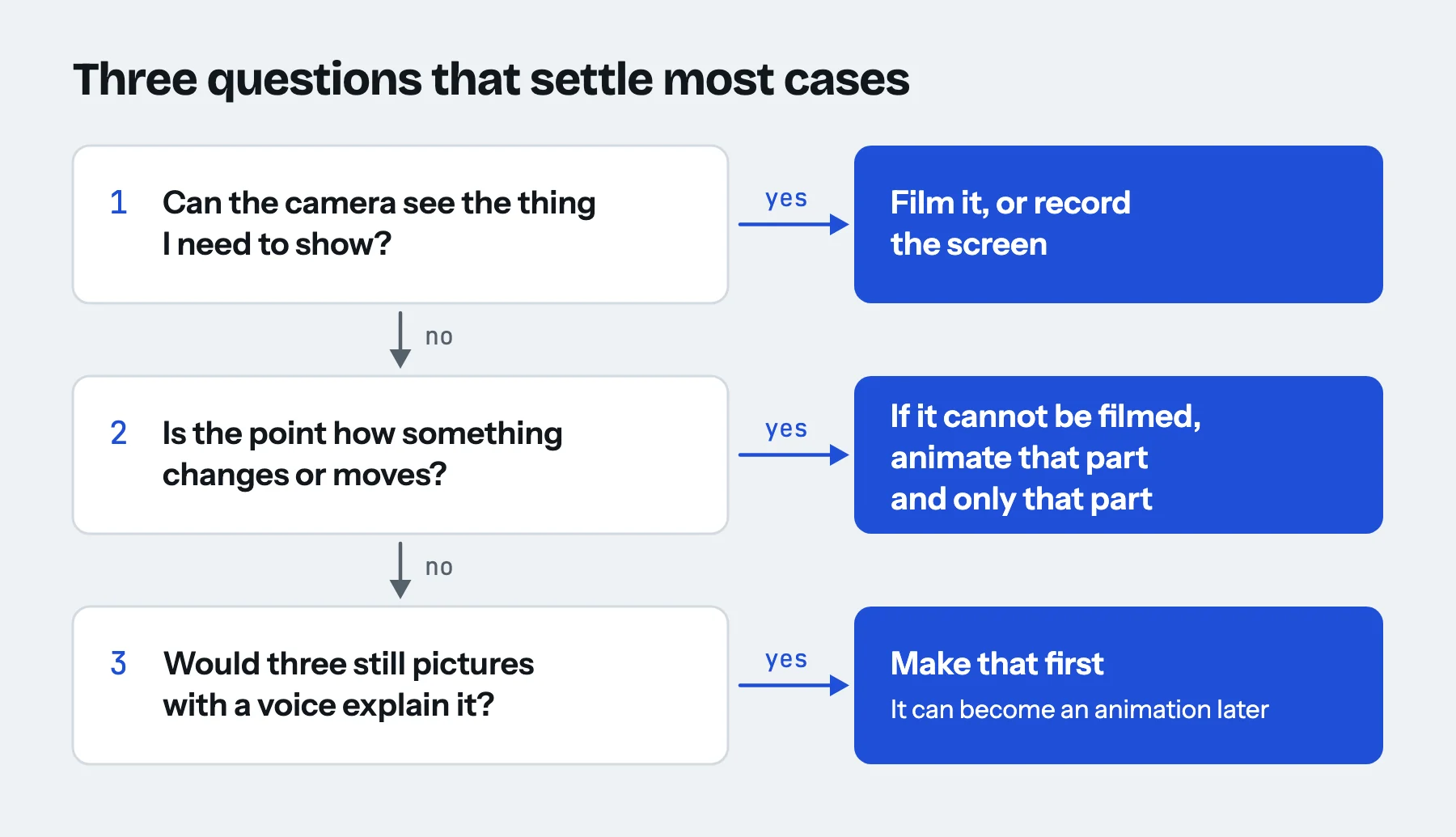
Three questions that settle most cases
- Can the camera see the thing I need to show? If yes, film it or record the screen.
- Is the point how something changes or moves? If yes, and it cannot be filmed, animate that part and only that part.
- Would three still pictures with a voice explain it? If yes, make that first. It can become an animation later if it proves worth it.
Questions and answers
Should you choose animated video or live-action video?
Choose by what the video has to show. Film a real thing, place or person, animate something that cannot be filmed, and show anything on a screen with a screen recording. The article does not claim that one of them sells better.
Is animation better at explaining than still pictures?
Not automatically. A 2021 paper in the journal Instructional Science sums up three meta-analyses that compared learning from animations with learning from still pictures: all three found an advantage for animation, and all three found it small. The advantage is real when the thing to be learned is the change itself, how something moves, speeds up or unfolds in time.
When is live-action video the right choice?
When the video has to show a real thing, place or person: a product someone will hold, a shop they will walk into, the person who will do the work, or a customer speaking. Viewers want to see the actual object, and a drawing of it answers a different question.
Which is easier to change later, an animation or filmed video?
An animation or a screen recording can be redone a section at a time. Filmed material usually means gathering the same people and place again, so film what will stay true: the person and the product, not this year’s price.
Sources
Every figure above comes from one of these pages, each read on the day this article was written. The year after each one is the year of its data or its last update.
- When learning from animations is more successful than learning from static pictures: learning the specifics of change. Ploetzner and others, Instructional Science, 2021. An experiment with 88 university students, with a summary of three earlier meta-analyses.
- Effective Educational Videos: Principles and Guidelines for Maximizing Student Learning from Video Content. Cynthia J. Brame, CBE—Life Sciences Education, 2016. Review of research on teaching with video.
Tools mentioned in this article
More articles
 How to make an engaging explainer videoEight steps in the order you would do them, each tied to what research on learning from video found.
 Corporate video examples: 11 worth studying, and what to borrow from eachEleven videos, each from the company’s own channel and each a different kind of corporate video, with the idea you can reuse from every one.