4 reasons to use video marketing, and what each one rests on
Four reasons to use video, the evidence each one rests on, and where that evidence is thin.
First published at this address: · Rewritten by Moovly Team,
Most advice on video marketing arrives with a wall of percentages and no way to check them. This article gives four reasons to use video, says what each one rests on, and says where the evidence is thin. If a reason does not fit your business, skip it: video is one way to explain and sell, and it is not the right one for every message.
1. The people you want to reach already watch video
In the United States, 84% of adults say they use YouTube, according to a Pew Research Center survey from 2026. How that differs by platform and by age is in our tips for social video.
These numbers are for the United States only, and “use” does not mean “watch business videos”. What they do show is that watching video online is an ordinary habit for most adults there, so a video does not ask that audience to do anything unfamiliar. Whether your own customers, in your own country, want video from you is something only your own numbers can answer; reason 4 is about finding that out cheaply.
2. Video shows what text has to describe
Some things are hard to put into words: how a product is assembled, where to click in a piece of software, what a finished result looks like. A short video shows the thing itself, in order and at real speed, where a written description leaves the reader to imagine it.
There is solid evidence that video helps people learn. A 2021 review of 105 randomized trials with 7,776 college students found that adding video to existing teaching led to strong learning benefits, and that replacing existing teaching with video led to small improvements. That research was done with students, not customers, so it supports “video is good at explaining” and nothing more specific than that.
People also go to video on purpose when they want to work something out. In a Pew survey of 4,594 U.S. adults in 2018, 51% of YouTube users said the site is very important for figuring out how to do things they have not done before, which Pew put at 35% of all U.S. adults. The survey is some years old and, again, from the United States, but it is an independent measure of the habit a how-to or product video relies on.
The evidence about buyers in particular is weaker. We found no independent survey of how people prefer to learn about a product. The one figure we can point to comes from a survey that Wyzowl ran in late 2025, in which 63% said a short video is how they would most like to learn about a product or service. Read it with care: the survey had 266 respondents in all, marketers and consumers together, and Wyzowl sells video production. It is a hint about what people say they like, not a measurement of what they do.
3. A video gives search engines one more way to show your page
Google’s documentation on video lists the places where a video from your site can appear: the main search results page, Video mode, Google Images and Discover. A video that meets the conditions in that documentation is eligible for those places; a page without a video is not.
Eligible is the important word. The same documentation says the page must already be indexed and “performing well in Search” before its video is considered at all, and that an indexed page does not mean the video will be indexed. A video will not rescue a weak page. It adds a route to a page that already deserves to be found. The technical side, with the rules Google publishes, is in our article on rules for video on your website.
4. You can start small, and reuse what you make
A useful video does not need a crew or a budget, and it does not need to be long. The clearest evidence on length comes from teaching: a review of research on educational video reports a study of 6.9 million viewing sessions in online courses, in which videos under 6 minutes were typically watched almost to the end, while for videos of 9 to 12 minutes the typical viewer watched about half. Those viewers were students, not customers, so do not read it as a rule for marketing; it is a good reason to make your first video a short one.
A first video can be made in an afternoon with what you already have:
- For software, a website or a slide deck, record your screen while you talk. Our Screen Recorder does this in the browser, with your microphone and a small webcam picture if you want one.
- For a message from a person, record yourself with the Webcam Recorder and trim the start and end.
- Caption it, so it can be followed with the sound off and by people who cannot hear it; the research on captions finds they help every kind of viewer. Automatic Subtitles makes a subtitle file from your recording, in a limited set of languages. Read the result before you publish it.
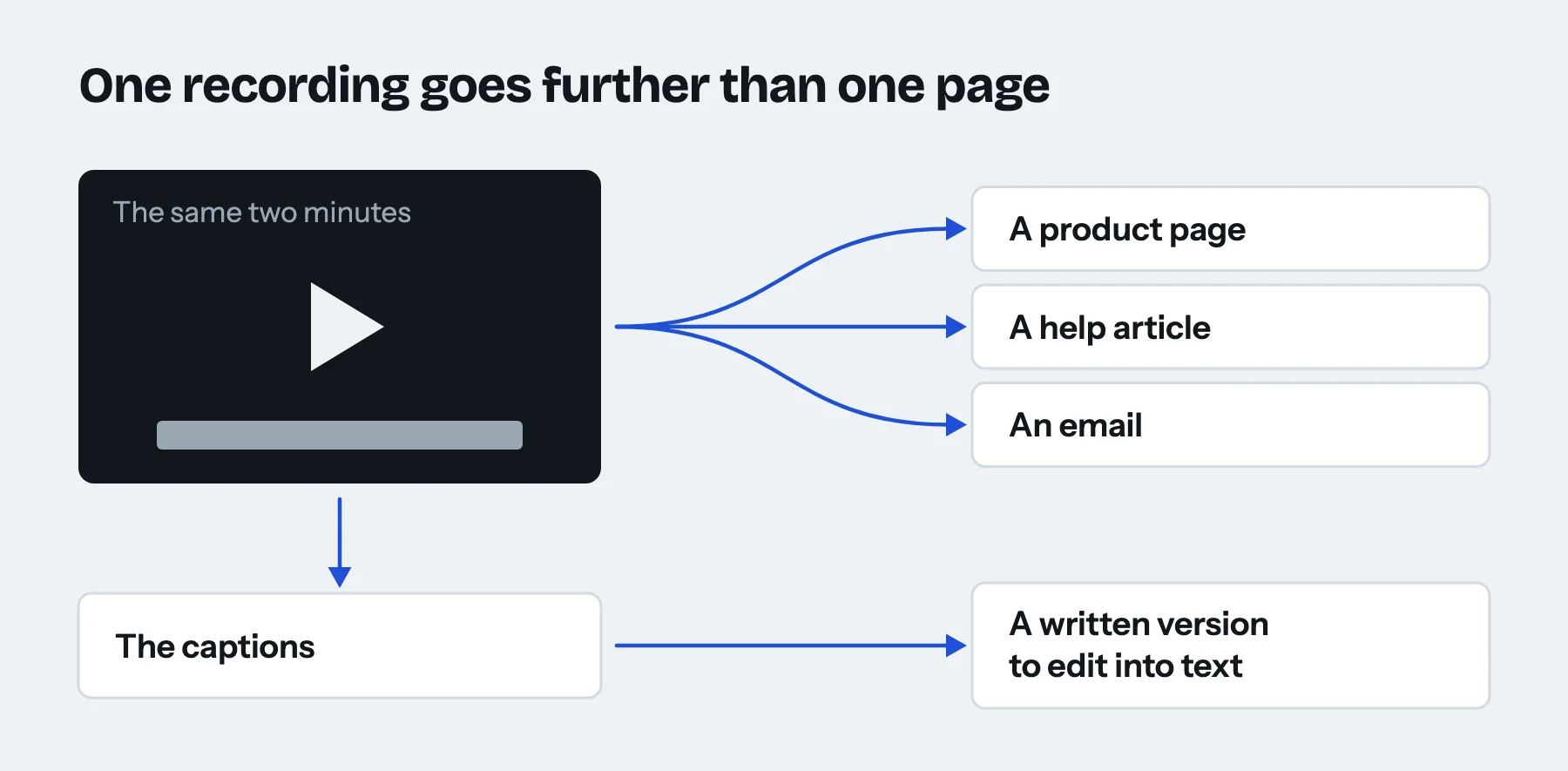
One recording also goes further than one page. The same two minutes can sit on a product page, in a help article and in an email, and the captions give you a written version to edit into text. Planning that reuse before you record keeps the cost per use low.
How to tell whether it worked
Decide before you record what the video is for, and pick one number that would show it. For a how-to video that might be fewer support questions about that step. For a product page it might be how many visitors go on to the next step, compared with the weeks before the video was added. Views alone tell you little: a video can be watched a lot and change nothing.
If the number does not move after a fair trial, that is a result too. Change the message, try a different page, or conclude that this message works better as text.
What video will not do
- It will not fix an unclear offer. If the page cannot say in a sentence what you sell and for whom, a video will repeat the confusion at greater length.
- It will not rank a page by itself: Google’s documentation says the page must already be performing well in Search before its video is considered.
- It does not suit every visitor. Some people prefer to read, some cannot play sound where they are, and some use a screen reader. Keep the key information in text on the page as well.
Questions and answers
Why should a business use video marketing?
The article gives four reasons: the people you want to reach already watch video, video shows what text has to describe, a video gives search engines one more way to show your page, and you can start small and reuse what you make. Video is not the right choice for every message, so skip a reason that does not fit your business.
Does adding a video help a page rank on Google?
Not by itself. Google’s documentation says the page must already be indexed and performing well in Search before its video is considered, so a video adds a route to a page that already deserves to be found and will not rescue a weak page.
How do you make a first marketing video without a crew or a budget?
Record your screen while you talk for software, a website or a slide deck, or record yourself with a webcam for a message from a person, and trim the start and end. Then caption it, so it can be followed with the sound off and by people who cannot hear it.
How do you know whether a marketing video worked?
Decide before you record what the video is for, and pick one number that would show it, such as fewer support questions about a step or how many visitors go on to the next step compared with the weeks before. Views alone tell you little, because a video can be watched a lot and change nothing.
Sources
Every figure above comes from one of these pages, each read on the day this article was written. The year after each one is the year of its data or its last update.
- Americans’ Use of Social Media in 2026. Pew Research Center, 2026. Survey of 5,511 U.S. adults, January to June 2026 (United States only).
- Video Improves Learning in Higher Education: A Systematic Review. Noetel and others, Review of Educational Research (summary by the American Educational Research Association), 2021. Review of 105 randomized trials with 7,776 college students.
- Many Turn to YouTube for Children’s Content, News, How-To Lessons. Pew Research Center, 2018. Survey of 4,594 U.S. adults, May and June 2018 (United States only).
- Video Marketing Statistics 2026. Wyzowl, 2025. Survey of 266 marketers and consumers in late 2025, run by a company that sells video production.
- Video SEO best practices. Google Search Central, 2025. Google’s documentation, last updated December 2025.
- Effective Educational Videos: Principles and Guidelines for Maximizing Student Learning from Video Content. Cynthia J. Brame, CBE—Life Sciences Education, 2016. Review of research on teaching with video.
- Video Captions Benefit Everyone. Morton Ann Gernsbacher, Policy Insights from the Behavioral and Brain Sciences, 2015. Review of more than 100 studies of captions.
Tools mentioned in this article
More articles
 Video on your website: 8 rules for visitors and for searchEight rules from published documentation, mostly Google’s own, each with a link so you can check it.
 10 benefits of using video in training and developmentSeven benefits that rest on published research, three that follow from what a recording is, and where video is the wrong tool.