Video in recruitment in 2026: what the research supports and 5 ways to use it
Four reasons to use video when hiring, two backed by research and two that are practical arguments, then five ways to use it, the care that video interviews need, and how to make a recruitment video.
Originally written by Maarten Dhondt,
Updated by Moovly Team,
Key takeaways
- Use a recruitment video to show the job honestly, including the hard parts, because the research on job previews points to honesty as what matters.
- Treat claims that video cuts hiring cost or time as untested until you have measured them in your own hiring.
- If you use recorded video interviews, explain to candidates why, tell them how the answers are judged, and offer another route to anyone who needs one.
- Before software scores a candidate's video, check the rules on automated assessment in the country, state or city where you hire.
- Caption every recruitment video, correct the automatic captions by hand, and publish a transcript next to it.
Video in recruitment means two different things, and they deserve different answers. The first is video an employer makes to attract applicants: a video job description, an employee story, a short message from the hiring manager. The second is video used to assess applicants: live and recorded video interviews. This article gives the reasons to use video that hold up in 2026, five ways to use it, the care that video interviews need, and how to make a recruitment video.
Do you need a video-based recruiting strategy?
You do not need a strategy document. You need to know which hiring problem a video would solve.
The case for video in hiring is often made with figures: lower cost per hire, shorter time to hire, more applications per posting. We did not find independent studies behind such figures, so this article gives none. If a vendor quotes such a number, ask for the study, the sample and the year.
What remains is smaller and more useful: two reasons with research behind them, and two that are practical arguments.
Four reasons to use video in recruitment
Reason 1: The medium changes how credible the message seems
A peer-reviewed experiment by Keely Frasca and Martin Edwards gave 342 participants, all with a degree or studying for one, the same standardized recruitment message in one of three forms: on Facebook, as a video, or as a text-based web page. The media differed in how rich and how credible participants found them, and credibility was positively related to attraction to the employer.
Keep the limits in view. This was an experiment with one message, not a count of real applications, and we read the abstract, not the full paper. What it supports: how believable a recruitment message feels matters, and the medium is part of that.
Reason 2: Video can show the job as it is
Researchers call an honest picture of a job, good parts and hard parts, a realistic job preview. A meta-analysis of 52 studies in Personnel Psychology, with about 17,000 participants in total, found that such previews affect voluntary turnover mainly by making people see the employer as honest.
Its abstract, which is the part we read, says the most effective preview may be an oral or written one given after hiring. So the research backs honesty, not video as such. Video is one practical way to deliver it: a day on the job, shown by the people who do it, including the early shift, the noise or the difficult customers. A candidate who decides the job is not for them has saved you both time.
Reason 3: Every candidate gets the same explanation (a practical argument)
A recorded explanation of the role, the team and the hiring steps is identical for every applicant, and nobody has to repeat it on each call. This is common sense, not a measured effect.
Reason 4: Video fits the places where you post jobs (a practical argument)
A careers page and a social profile can both carry video, so one short video can be reused in several places. Whether that reaches people who are not looking for a job, or one age group more than another, is something to test on your own posts. We found no solid source for either claim and make neither.
Five ideas for using video in recruitment
Idea 1: Video job descriptions
Put a short video next to the written job posting, not in place of it. Let the hiring manager say what the person will do in the first months, who they will work with and what makes the job hard. Keep pay, location and requirements in text, where candidates can search and copy them.
Idea 2: Videos on your careers site
Visitors to a careers page want to know what working there is like. Give them real colleagues talking about real tasks. Let them speak in their own words. That is our suggestion; the study above did not compare scripted and unscripted video. Our corporate video examples include one recruitment video, Duolingo's "Life at Duolingo - What it's like working here" from 2024, in which employees talk about their work.
Idea 3: Videos on social profiles
Cut the careers-page video down for each network, and add captions for people who watch without sound. Our tips for social video and Instagram Story ideas go into the formats. If colleagues share a video on their own profiles, that is their choice to make.
Idea 4: Video messages to candidates
A recorded message can confirm that an application arrived and explain the next steps, or introduce the interviewers before an interview. Send it as a link in an email with the same information in text.
Idea 5: Video interviews
A live video interview is a normal interview held on a video call. A recorded, or asynchronous, interview is different: the candidate records answers to set questions alone, and the employer views them later. It saves scheduling, and it is the idea on this list that needs the most care.
Video interviews: fairness, candidates and the rules
What research says about candidates
A study in the Journal of Personnel Psychology asked two groups about recorded interviews. In a US online panel of 160 people who only read a description, ratings were fairly favorable. Among 103 real applicants for a Dutch legal traineeship, who had recorded three answers of up to one minute each at home, ratings of fairness and of the chance to show their skills were low. The authors conclude that actual applicants considered the video application rather unfair. In both groups, extraverted people saw more opportunity to perform, and the authors advise recruiters to reconsider the format when extraversion is not relevant to the job. These are two small samples, and the authors themselves ask for replication.
Explanations help. A study by Basch and Melchers found that an explanation stressing the standardization of recorded interviews improved fairness perceptions, and one stressing flexible scheduling improved perceived usability. Older participants accepted video interviews less. We read the abstract of this study, not the full paper.
Automated scoring adds a second problem. A mini review of seven studies with more than 1,300 participants in total found mixed views on overall fairness, and mostly negative views on two points: people felt less able to influence an algorithm's judgment, and they missed human warmth. The review names as a major limitation that these studies used hypothetical scenarios, not real applicants.
Practical steps that follow (our suggestions): tell candidates why you use a recorded interview and who will view it, give a practice question, allow a second take, keep it as one step among several, and offer another format to anyone who asks.
The rules on automated assessment
This part is information, not legal advice. It names four places because their authorities have published on the subject. If you hire elsewhere, check your own rules, and ask a lawyer before software scores a candidate.
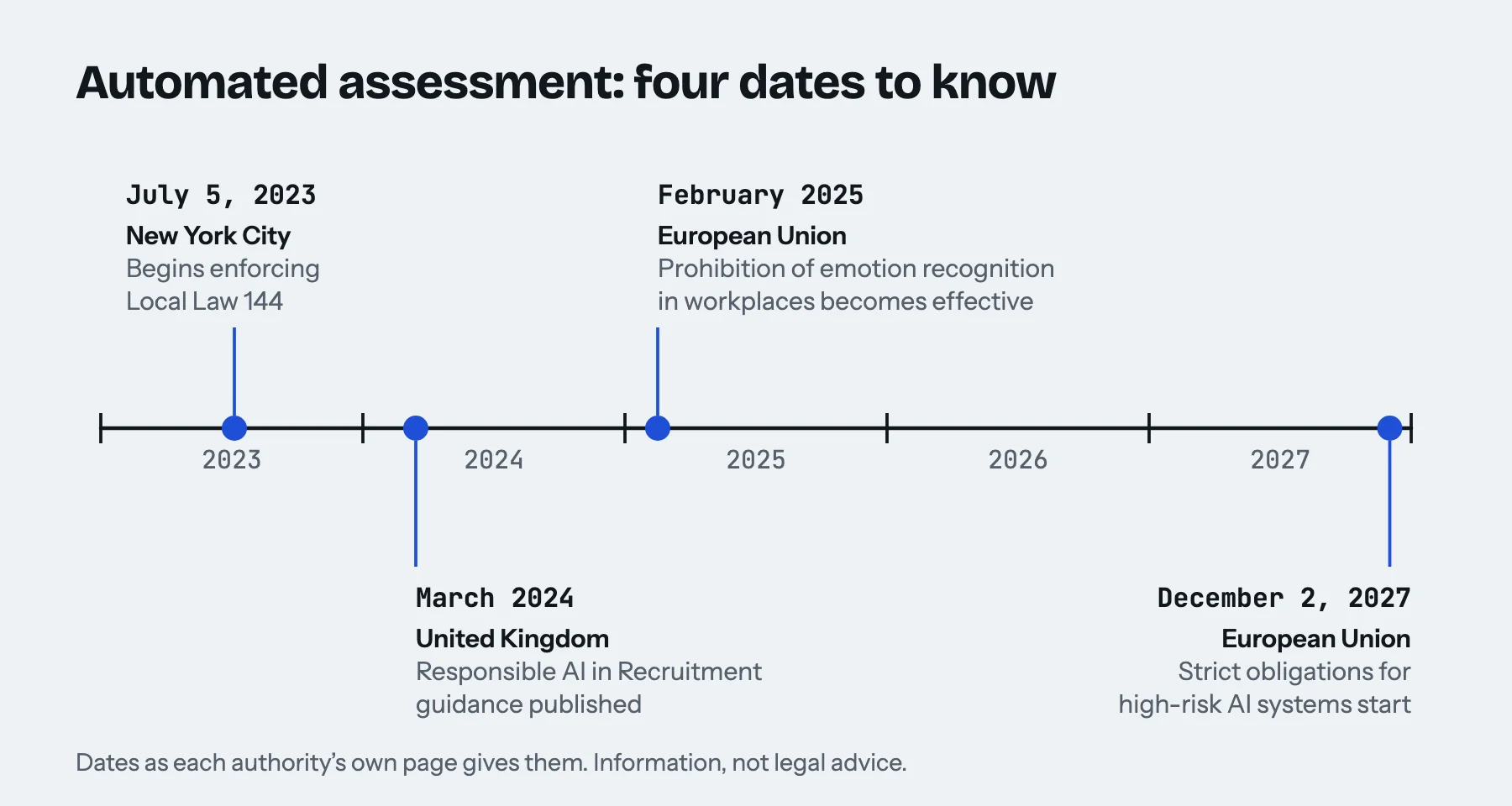
- United Kingdom. The government's Responsible AI in Recruitment guidance, published in March 2024, warns that facial recognition systems have different error rates across demographic groups, that there is little to no scientific consensus on the validity of inferring emotion, and that transcription tools can be biased against regional and non-native English speakers. It tells employers to disclose the use of AI to applicants, to complete a data protection impact assessment, and to consider reasonable adjustments for disabled applicants under the Equality Act 2010.
- European Union. The European Commission's AI Act page, updated on November 25, 2026, lists AI tools for employment, such as CV-sorting software for recruitment, among high-risk uses, and lists emotion recognition in workplaces among prohibited practices. It says that this prohibition became effective in February 2025 and that high-risk AI systems will be subject to strict obligations starting on December 2, 2027.
- United States. An EEOC fact sheet, a file from April 2024 that was on the agency's site in November 2026, says federal discrimination laws apply to AI in employment as they do to other employment practices. Its example is video interviewing software that scores an applicant low because a disability affects their speech patterns. Check the EEOC's site for its current guidance.
- New York City. The city's page on automated employment decision tools says Local Law 144 prohibits employers and employment agencies from using such a tool unless it has had a bias audit within one year of its use, information about the audit is public, and certain notices have gone to employees or job candidates. The page gives July 5, 2023 as the date the city began enforcing it. Whether a given product counts as such a tool is a legal question.
Treat a candidate's recording as personal data. Decide before you collect it who can view it, where it is stored and when it is deleted, and tell the candidate.
How to create a recruitment video
These steps hold for any camera and any software.
- Pick one job or one question. "What does a support engineer do here all day?" makes a better video than "why we are a great employer".
- Choose who speaks. The hiring manager for the role, or someone who does the job now.
- Outline, do not script. List three or four points and let the person use their own words.
- Record simply. A quiet room, light on the face, the camera at eye level. For a hiring manager's short message, a browser tool such as our Webcam Recorder is enough. For a software job, a recording of the screen can show the actual work.
- Trim the start and the end, and stop when the points are made.
- Caption it and add a transcript (next section).
- Publish it next to the written posting, then cut shorter versions for social profiles.
- Review it when the role, the team or the office changes. An outdated video is a dishonest preview.
Filming colleagues raises questions of consent, and the answer depends on the country. Our guide to video in internal communications covers that point; read it before you ask anyone to appear on camera. If you make everything yourself, video for a small business is the place to start, and how to create training videos takes over once the person is hired.
Accessibility: captions and transcripts
A recruitment video that some candidates cannot follow shuts them out at the first step. W3C's page on captions describes them as a text version of the speech and the non-speech audio needed to understand the content, and lists them at Level A of its accessibility guidelines for prerecorded video with audio. It says automatic captions often do not match the spoken audio and need editing. If you start from automatic captions, for example with our Automatic Subtitles tool, check names, job titles and figures by hand.
W3C's page on transcripts separates a basic transcript, which gives the audio as text, from a descriptive one, which also describes what is shown and is what people who are both deaf and blind need. A transcript on the job page also lets every candidate scan the content without playing the video.
Give the same thought to video interviews: a candidate who cannot use the format needs another route, offered without having to argue for it.
Questions and answers
What is video in recruitment?
It covers two different things. One is video made by the employer to attract applicants: a video job description, an employee story, a message from the hiring manager. The other is video used to assess applicants: live video interviews and recorded (asynchronous) ones.
Do recruitment videos bring in more applicants?
We found no independent study that measures this, so this article does not claim it. One peer-reviewed experiment found that the medium of a recruitment message changed how credible it seemed, and that credibility went with attraction to the employer. Test it on your own job ads if the number matters to you.
Are recorded video interviews fair to candidates?
The research cited here found doubts. In a 2019 study, 103 real applicants for a Dutch traineeship rated a recorded video interview as rather unfair. Another study found that explaining the standardization of the format improved fairness ratings.
Is it legal to let AI score video interviews?
It depends on where you hire, and this is information, not legal advice. New York City requires a bias audit and notices before an automated employment decision tool is used, and the European Commission lists AI tools for employment among high-risk uses under the EU's AI Act. Check the rules of your own country, state and city.
Do recruitment videos need captions?
W3C lists captions for prerecorded video with audio at Level A of its accessibility guidelines. Captions give candidates who are deaf or hard of hearing the speech as text, and W3C says automatic captions need editing for accuracy.
Sources
The facts and figures above come from these pages, each opened and read for this update. The year after each one is the year of its data or its last update.
- Web-based corporate, social and video recruitment media: Effects of media richness and source credibility on organizational attraction. International Journal of Selection and Assessment (Frasca and Edwards), 2017. Peer-reviewed experiment with 342 participants; abstract read.
- Mechanisms linking realistic job previews with turnover: A meta-analytic path analysis. Personnel Psychology (Earnest, Allen and Landis), record in the University of Warwick repository, 2011. Peer-reviewed meta-analysis of 52 studies; abstract read.
- Applicant Perceptions of Initial Job Candidate Screening With Asynchronous Job Interviews: Does Personality Matter?. Journal of Personnel Psychology (Hiemstra and colleagues), copy in the VU Amsterdam research portal, 2019. Peer-reviewed study with a US online panel and real Dutch applicants; full text read.
- Fair and Flexible?! Explanations Can Improve Applicant Reactions Toward Asynchronous Video Interviews. Personnel Assessment and Decisions (Basch and Melchers), 2019. Peer-reviewed study; abstract read.
- Robots are judging me: Perceived fairness of algorithmic recruitment tools. Frontiers in Psychology (Hilliard, Guenole and Leutner), 2022. Peer-reviewed mini review of seven studies, open access.
- Responsible AI in Recruitment. UK Department for Science, Innovation and Technology, 2024. UK government guidance for organizations that buy and use AI in recruitment.
- AI Act. European Commission, 2026. The European Commission's own page on the EU's AI Act.
- What is the EEOC's role in AI?. US Equal Employment Opportunity Commission, 2024. One-page fact sheet of the US federal agency that enforces employment discrimination law.
- Automated Employment Decision Tools (AEDT). New York City Department of Consumer and Worker Protection, 2025. The city agency's own page on Local Law 144.
- Captions/Subtitles. W3C Web Accessibility Initiative, 2024. W3C's own page on captions and automatic captions.
- Transcripts. W3C Web Accessibility Initiative, 2024. W3C's own page on basic and descriptive transcripts.
Free tools for this
More articles
- Corporate video examples: 11 worth studying, and what to borrow from eachEleven videos, each from the company’s own channel and each a different kind of corporate video, with the idea you can reuse from every one.
- Video in internal communications: a 2026 guide to what to make and howWhen a recording beats an email or a meeting, the eight kinds of internal video worth making, and the parts that are easy to skip: captions, translation, consent and how long to keep the file.
- How to create training videos for employees: a 2026 guideWhy it pays to make your own, the five types of training video and when each one fits, and a method that starts with one task and ends with a check of whether people can now do it.