Corporate video examples: 11 worth studying, and what to borrow from each
Eleven videos, each from the company’s own channel and each a different kind of corporate video, with the idea you can reuse from every one.
First published at this address: · Rewritten by Moovly Team,
“Corporate video” covers very different jobs: showing what a product does, letting a customer speak, explaining how something works, teaching a procedure, telling where the company came from, hiring, reporting on the year. Below are eleven corporate video examples, one of each kind and one of them a cautionary one, each from the company’s own YouTube channel. We went through each one for this article with its captions on and describe only what is on screen and in its captions. The links go to the companies’ own uploads; nothing is embedded or copied here.
Most of these are large companies with large budgets, and we have no independent figures on what any of the videos achieved for them, so none are given as results. What can be borrowed is the idea in each, and nearly every idea below also works with a phone and an afternoon.
What is a corporate video?
A corporate video is any video a company makes about itself, its work or its products, as opposed to one made about it by someone else. The name says who is speaking, not what kind of film it is: a ninety-second advertisement, a nine-minute assembly instruction and a chief executive reading out the year’s results are all corporate videos.
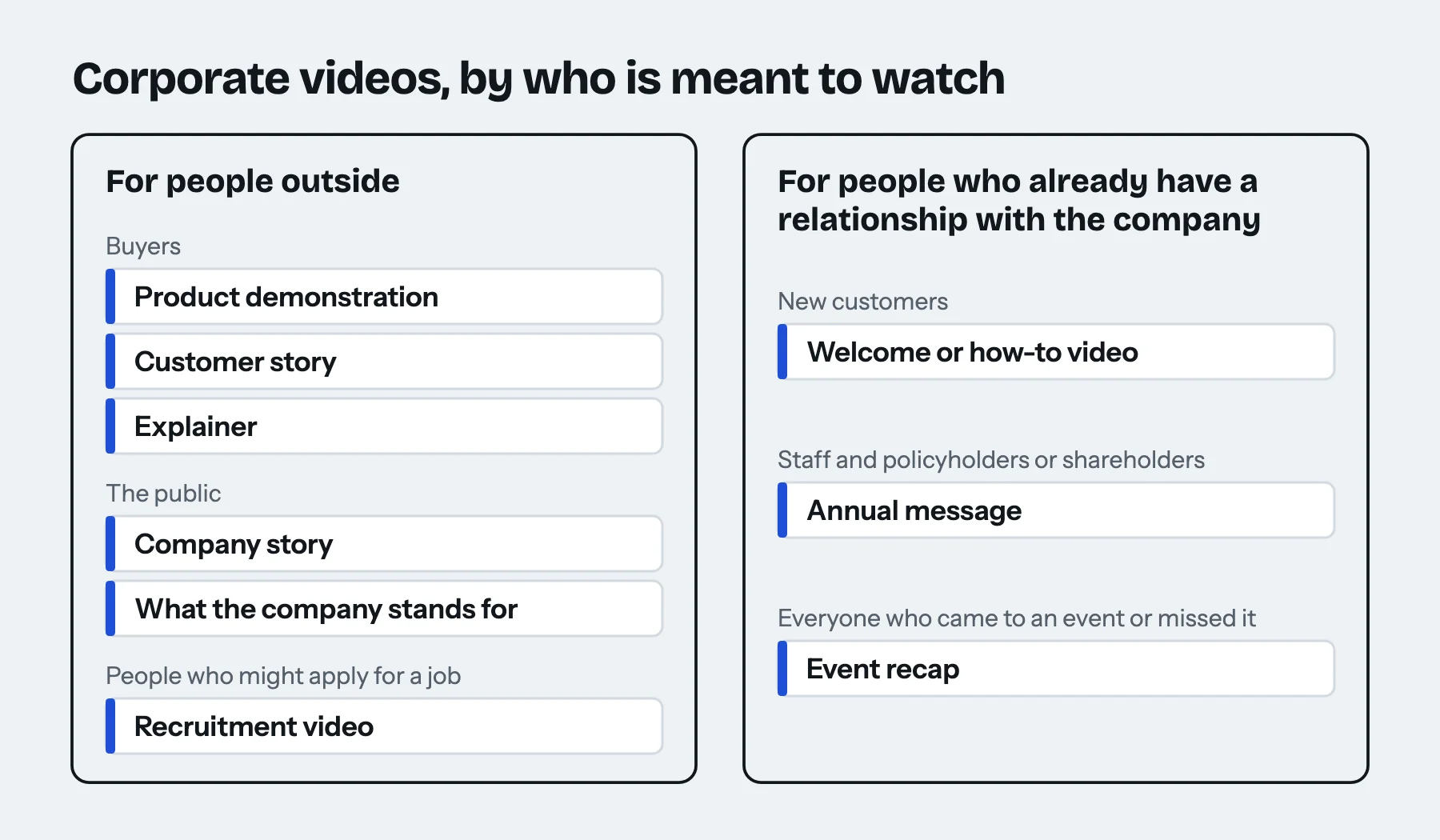
It helps to sort them by who is meant to watch. Some are for people outside: buyers (a product demonstration, a customer story, an explainer), the public (a company story, a film about what the company stands for), people who might apply for a job (a recruitment video). Some are for people who already have a relationship with the company: new customers (a welcome or how-to video), staff and policyholders or shareholders (an annual message), and everyone who came to an event or missed it (a recap). The eleven examples below are arranged by these jobs.
Why companies make them
The plain reasons are the ones the list above implies. Some things are easier to show than to describe: a steering system holding two trucks steady, the order in which a wardrobe goes together. A face and a voice carry what a page of text does not, which is why customers, employees and chief executives are put in front of a camera. And a video can be made once and watched by every new customer or new colleague without anyone repeating themselves.
Whether video does these jobs better than text or a photograph is a separate question with real research behind it. The evidence on video in marketing is in four reasons to use video marketing, and the evidence on video for teaching and instruction is in ten benefits of video in training and development; neither is repeated here.
1. A product demonstration: Volvo Trucks, “The Epic Split” (2013)
The video runs 1 minute 17 seconds. It opens close on a man standing still with his eyes closed; the captions speak of “bumpy roads and heavy winds”. The camera pulls back: he is standing with one foot on the wing mirror of each of two trucks, and the trucks are reversing side by side. They drift apart until he is in a full split between them, against a low sun. Only then does a line of text appear: “This test was set up to demonstrate the stability and precision of Volvo Dynamic Steering.”
According to Volvo’s own description under the video, it was filmed in one take on a closed landing field in Spain at sunrise, and the steering system is what the test was built to show.
What to borrow: one claim, shown and not stated. The video makes a single point about the product, proves it in a way a viewer can see, and names the feature in one sentence at the end. A screen recording that shows your software doing the one thing it is good at, without a list of features, follows the same plan.
2. A customer story: Slack, “So Yeah, We Tried Slack …” (2014)
This one is 2 minutes 20 seconds. It begins with an email on a screen, from one of Slack’s founders to a video production company. Then the people of that video company sit on a sofa in their own office and talk to the camera about using the product: one describes it as putting “multiple forms of messaging and file sharing into one app”, another lists the other tools it connects to while their logos drift past her, and a pair say what they like about it. Near the end a phone in a hand shows the app.
Slack’s description under the video says the production company first declined the job, became a user some months later, and then made this video about its own experience.
What to borrow: the customer does the talking, in their own workplace, and admits the doubt they started with. A real customer answering three questions on a webcam does this job; what matters is that the words are theirs. Ask for permission in writing before you publish someone’s face and name.
3. An explainer: Google, “How Google Search Works (in 5 minutes)” (2019)
The video lasts 5 minutes 15 seconds. A narrator explains over simple moving drawings: turning gears at the start, arrows pointing at a sample results page as the captions say “there are hundreds of factors”, a search box where someone “searches for lasagna, or resume writing tips”, a star landing on a result when the narrator comes to what “makes a good result good”. It ends on a card with two links, one to learn more about Search and one to the guidelines it mentioned.
What to borrow: one running example, and pictures that show the thing the voice is naming at that moment. The lasagna search comes back again and again, so the viewer never has to hold an abstract idea without a case. The last screen tells the viewer where to go next. Our guide to making an explainer video goes through the steps.
4. A safety briefing that entertained, and was withdrawn: Air New Zealand, “It’s Kiwi Safety” (2018)
The airline’s safety briefing is 4 minutes 37 seconds and written in rhyme. A crowd dances in a city street as the captions announce “Kiwi Safety is the title, here we go”. The instructions are all there: a child pulls on an oxygen mask to the line “Don’t worry if the bag doesn’t inflate”, a row of people in life jackets follow “Place it over your head, don’t forget to click the straps”, and an aircraft drawn on the ground, seen from above, shows arrows to the exits as the crew are told to “show ’em where the exits at”. The airline’s description calls it the largest safety video it had produced, with a cast of 600 that includes local musicians.
It did not last. The video went up in November 2018, and by 1 February 2019 The New Zealand Herald reported that it had been removed from flights and replaced by an earlier one. The criticism it records is about the briefing, not the music alone: a government minister said the video “trivialises safety” and called it “a juvenile mishmash”, and said tourists he had sat beside on flights were confused by it. Visiting musicians who saw it on board criticised it publicly, and a column in the same paper called it “unbearable”.
The airline gave a different reason: according to the Herald, it said the change was based on a new campaign to promote domestic travel and tourism to Northland. It also answered with a joke. As 1News reported, it posted a mock job advertisement for a “Head of Safety Videos”, which claimed 21 million views for the video, called it “loved for its music, as well as for the clarity of its safety instructions”, and advised readers not to read the comments online. The video is still on the airline’s own channel, which is where we watched it.
What to borrow, and what to avoid: the lesson runs both ways. What worked: a briefing that passengers usually ignore got watched and talked about, every instruction is still said and shown one at a time, with the action on screen as it is named, and when the criticism came the airline could laugh at itself. Where it went wrong, on the critics’ account: the form became the subject. The minister’s complaint was that visitors were confused by it and that it made safety look trivial, and a safety message that the people it is for find confusing or trivial has failed at its one job, whatever the view count. For your own compulsory material the test is simple: show it to someone who has never seen the procedure and ask them to repeat the steps. If they remember the song and not the steps, cut the song.
5. A company story: LEGO, “The Story of LEGO: How It All Started” (2012)
This animated film runs a little over 17 minutes, by far the longest here. The narrator starts from a brick, “You’ve probably seen one of these”, and asks whether you have wondered “how it all started, and why it’s called Lego”. Then the story begins in a carpenter’s workshop: Ole Kirk Christiansen stands at the red door of a brick building as the captions say he “didn’t have much money and had to dismiss his last worker”. A young man comes to a door and asks, “Is there something wrong, Dad?”
The film goes on through the years in scenes like that one: two men at a desk as the captions reach the second World War, a conversation on the deck of a ship, a factory hall where “the many guests and business connections who visited the company always wanted to see the modeling department”, which leads to the idea of a park. Near the end, before the credits, the narrator turns out to be the founder’s grandson, speaking of “my grandfather” and “my father”. LEGO’s description under the video calls it a look back at the group’s history.
What to borrow: the bad years are in it. The story opens with a dismissal and a workshop that has closed, and that is why the later scenes mean something. A company history told as a list of successes is a brochure; one that says what nearly went wrong is a story. It is also told by someone with a reason to tell it. You do not need animation for this: one person who was there, telling it in order, with old photographs, does it.
6. What the company stands for: Patagonia, “Unfashionable” (2024)
This one is 54 seconds. It is cut from many short clips with spoken lines running over them: a small figure wading in a wide brown river, a worker handling red fabric on a long table, an upright clip of someone holding up a garment in its plastic bag, two people in yellow jackets on a sailing boat in a grey sea. The captions run across them: “fashion is none of our business”, then that making clothes “is just as serious” as the climbing equipment the company started with.
Past the halfway mark a question appears in large letters over the boat, “Saving the planet?”, as a voice asks what a quality rain jacket has to do with it. The answer in the captions is that well-made products mean buying fewer of them, and near the end comes the line “we’re in business to save our home planet”.
What to borrow: it argues against something. The film names what the company refuses to do, and says an uncomfortable thing about its own industry, before it says what it is for. A statement of values that nobody could disagree with tells the viewer nothing; one that costs the company something is worth a minute. It also puts the obvious objection on screen as a question and answers it.
7. A recruitment video: Duolingo, “Life at Duolingo - What it’s like working here” (2024)
The video is 3 minutes 19 seconds and opens on the words “why we work at duolingo” over two people at a table. After that it is employees in the office, alone or in pairs, talking to someone beside the camera. Parts of it open with a title on screen; one, “our diversity”, appears over a shelf of coloured owl figures. A speaker’s first name and team are shown beside them, such as “megan, Design”.
What they say is specific. One describes the first day as like walking into a school lunchroom where you know nobody, until someone called her over to their table; the same passage mentions that meetings stop for lunch every day. A designer tells of being left in charge of a product area when her co-lead went on parental leave, and calls it one of the scariest things. The description under the video gives the link to the job listings.
What to borrow: small true details in place of adjectives. “A welcoming culture” is what every employer says; the lunch table and the frightening weeks in charge are things only this one could say. Ask colleagues for one thing that happened to them, record them in pairs so they talk to each other and not to the lens, and put the link to the vacancies where the viewer will look next.
8. A welcome for new customers: Zapier, “Welcome to Zapier!” (2020)
This one takes 50 seconds. A man greets the viewer from an ordinary room, then the picture cuts to a drawn card labelled “Email received” on a plain background as he talks about time spent on “repetitive, but business critical, tasks”. A second card, a to-do table, slides in beside it, and the name and address from the email appear in the table’s rows. That is the product’s idea, apps passing information to each other, shown with two rectangles.
Then the screen fills with a wall of colored cards while the captions list the chores a viewer might hand over, “those annoying CSVs” among them, and the narrator sends the viewer to the app directory. It ends on the logo. Zapier’s description now says there is a newer version of the course this video opened.
What to borrow: a first video for a new customer should do one thing and stop. This one does not tour the menus. It starts from the viewer’s own nuisance, shows a single example of the product removing it, and gives one next step. Under a minute is enough for that, and the detailed lessons can follow in their own videos.
9. An instruction without words: IKEA UK, “BRIMNES Wardrobe with 3 doors assembly instructions” (2022)
The video is 9 minutes 26 seconds of computer-drawn assembly. It begins with a blue screen showing every screw, dowel and fitting with its count beside it. Then the panels lie on a grey floor, and each step carries its number in the top corner, as in the printed leaflet; the points we looked at were steps 15, 26, 37 and 43.
A round symbol in the bottom corner shows which tool the step needs: a screwdriver while a bracket is fixed under the top panel, a hammer while the back is nailed on. Nobody appears, and the automatic captions show “[Music]” almost throughout, with a few stray words that look like the machine’s mistakes. IKEA’s description links to the printed instructions for the same wardrobe.
What to borrow: a procedure can be taught with numbered steps and no language at all, which means one video serves every country. Count out the parts before starting, show one action per step, keep the camera where the hands would be, and number the steps the same way as the written version so a viewer can move between the two. For software, the same plan is a screen recording with one numbered action at a time.
10. An annual message: Sentry, “2025 Annual Report: A message from Chairman and CEO Pete McPartland” (2026)
This message from the American insurer lasts 4 minutes 8 seconds. One man in a suit stands against a plain pale-blue background, with his name and title, “Chairman and CEO”, shown beside him at the start. He begins “Hi, this is Pete” and says the year was a very successful one for the company, “but certainly not without its challenges”.
He keeps to that. Between the good news he names what was hard for the company and its industry: falling prices in one line of business, the rising cost of injury claims in another, and the year’s wildfires, which he says barely touched the company. While he speaks of the difficult year the picture changes to traffic on a road at sunset. Near the end a result comes up as a large text card reading “$8.7 billion surplus”, with a note in small print beneath it, and he closes by thanking the staff, the retired staff and the board.
What to borrow: this is one of the simplest videos on the list, and it works because of what is said. The person responsible speaks in his own name, puts the difficulties next to the successes, and shows the figure on screen as he says it, with its footnote. At its simplest, a message to staff or members made this way needs a camera, a plain wall and a script that does not hide the bad quarter.
11. An event recap: Web Summit, “Web Summit 2025 | Highlights” (2025)
The recap is one minute long, from the company that runs the conference. It is a run of short shots: people with badges round their necks walking towards the venue past a tower block, a row of national flags in a dark arena, visitors bent over a table-football game, speakers on the lit stage under the event’s name, one of them in an armchair holding up a shirt. It ends on the logo.
The automatic captions show little but “[music]” and a stray word or two, and the page gives no description. The film does not explain the event; it shows who was there and what the days looked like.
What to borrow: a recap is for two groups, those who came and want to see themselves, and those deciding whether to come next time. Both are served by faces and variety more than by slides and speeches, so film the arrivals, the crowd and the things people did between sessions, keep each shot to a second or two, and stop at a minute. One thing to do better: say in the description what the event was and when the next one is.
What the eleven have in common
- Each has one job. None tries to demonstrate, explain, reassure and recruit at once. The one that ran into trouble is the one where entertaining began to compete with that job.
- Most are short. Three run a minute or less, and nine of the eleven are under six minutes. The two long ones have a reason: an assembly that a viewer follows step by step, pausing as they go, and a history told as a film.
- Each shows the thing it talks about at the moment it talks about it: the split, the app, the search box, the life jacket, the tool for the step, the figure the chief executive has just named. That alone was not enough for the safety briefing: the words also have to be easy to follow.
- Where people speak to the camera, in most of these they are the people concerned: the customer, the employees, the chief executive. That is cheaper than hiring a presenter, and it is what makes the words believable.
- All of the videos with speech have captions on YouTube, which is how the lines quoted above could be read. Some are YouTube’s automatic ones, and those get names wrong, the company’s own name included.
Making your own version, small
- For a demonstration, an explainer or a welcome video for software, record the screen with your voice. Our Screen Recorder does that in the browser.
- For a customer, a colleague or the head of the company speaking, the Webcam Recorder records camera and microphone; trim the ends and leave the rest alone.
- Add captions, and do not leave them to chance. Automatic Subtitles makes a subtitle file from the speech, in a limited set of languages; read it through and correct names before you publish.
How these were chosen, and what we did not check
Each video was opened on the channel of the company that made it, and its length and upload year are as shown there in November 2026. Of the seven added in this update, the channels of LEGO, Patagonia, Duolingo and Web Summit carry YouTube’s verification mark, and those of Zapier, IKEA UK and Sentry are the ones those companies link to from their own websites. We looked at each video at five or six points along its length with captions on, not at every second of it, and the descriptions above are limited to what we saw and read there. The sound was not part of that, so nothing is said about music or tone of voice beyond what the captions and the companies’ own descriptions state; where we write that the captions show little but music, that is what the captions show, not something we listened for.
The eleven were picked to cover eleven kinds of corporate video, after looking at which kinds the pages that rank today for “corporate video examples” include. Kinds that companies rarely publish, such as internal announcements and staff training, are missing for that reason. These are examples, not a ranking, and there are certainly others as good.
Questions and answers
What is a corporate video?
A corporate video is any video a company makes about itself, its work or its products, as opposed to one made about it by someone else. The name says who is speaking, not what kind of film it is.
What kinds of corporate video are there?
The article sorts them by who is meant to watch. For people outside the company there are product demonstrations, customer stories, explainers, company stories, films about what the company stands for and recruitment videos. For people who already have a relationship with the company there are welcome or how-to videos, annual messages and event recaps.
How long are the corporate video examples in this list?
Most are short: three run a minute or less, and nine of the eleven are under six minutes. The two long ones have a reason: an assembly that a viewer follows step by step, and a history told as a film.
Can a small company borrow from these corporate video examples?
Most of the eleven come from large companies with large budgets, but what can be borrowed is the idea in each, and nearly every idea also works with a phone and an afternoon. For a demonstration, an explainer or a welcome video for software, a screen recording with your voice is enough.
Sources
Every figure above comes from one of these pages, each read on the day this article was written. The year after each one is the year of its data or its last update.
- Volvo Trucks - The Epic Split feat. Van Damme. Volvo Trucks, on its own YouTube channel, 2013. The video itself (1 minute 17 seconds), viewed with captions for this article.
- “So Yeah, We Tried Slack …”. Slack, on its own YouTube channel, 2014. The video itself (2 minutes 20 seconds), viewed with captions for this article.
- How Google Search Works (in 5 minutes). Google, on its own YouTube channel, 2019. The video itself (5 minutes 15 seconds), viewed with captions for this article.
- It’s Kiwi Safety #AirNZSafetyVideo. Air New Zealand, on its own YouTube channel, 2018. The video itself (4 minutes 37 seconds), viewed with captions for this article.
- Air New Zealand’s hilarious ‘advert’ for Head of Safety Videos after being slammed for safety rap. The New Zealand Herald, 2019. News report, 1 February 2019.
- Air New Zealand pokes fun at itself after much-maligned rap safety video pulled. 1News (TVNZ), 2019. News report, 2 February 2019.
- The Story of LEGO: How It All Started | LEGO Mini Movie. LEGO, on its own YouTube channel, 2012. The video itself (17 minutes 10 seconds), viewed with captions for this article.
- Unfashionable. Patagonia, on its own YouTube channel, 2024. The video itself (54 seconds), viewed with captions for this article.
- Life at Duolingo - What it’s like working here. Duolingo, on its own YouTube channel, 2024. The video itself (3 minutes 19 seconds), viewed with captions for this article.
- Welcome to Zapier!. Zapier, on its own YouTube channel, 2020. The video itself (50 seconds), viewed with captions for this article.
- IKEA BRIMNES Wardrobe with 3 doors assembly instructions. IKEA UK, on its own YouTube channel, 2022. The video itself (9 minutes 26 seconds), viewed with captions for this article.
- Sentry 2025 Annual Report: A message from Chairman and CEO Pete McPartland. Sentry Insurance, on its own YouTube channel, 2026. The video itself (4 minutes 8 seconds), viewed with captions for this article.
- Web Summit 2025 | Highlights. Web Summit, on its own YouTube channel, 2025. The video itself (1 minute), viewed with captions for this article.
Tools mentioned in this article
More articles
 How to make an engaging explainer videoEight steps in the order you would do them, each tied to what research on learning from video found.
 4 reasons to use video marketing, and what each one rests onFour reasons to use video, the evidence each one rests on, and where that evidence is thin.